Intermittent Bonded Ribbon Production Line Available For Sale
A specified speed of 600 m/min gives this equipment considerable production capacity for optical-fiber applications. Prospective buyers should confirm the achievable speed, machine setup, and required operating conditions directly with the manufacturer before proceeding.
Shanghai Weiye OFC provides a system engineered to manufacture 12- and 16-fiber rollable ribbons. Its product description presents the equipment’s capabilities, technical specifications, and included systems, providing U.S. buyers with a basis for comparing their equipment requirements.
Review the listed configuration in the product description, then contact the supplier about pricing, installation, and options specific to your project. This approach helps determine which equipment details apply to your particular manufacturing site and goals.
The listed address for Shanghai Weiye Optic Fiber Communication Equipment Co., Ltd. is 201 Minyi Road, Songjiang District, Shanghai. Use the product page for initial reference and verify current technical and commercial information directly with the company. Submitting a clear request for pricing and specifications can help you move forward with the assessment.
SZ Stranding Line
Compact Fiber Unit
Fiber Ribbone Line
Key Takeaways
- A speed of 600 m/min is listed, but buyers should verify the operating conditions with the manufacturer.
- This equipment supports production of 12-fiber and 16-fiber rollable ribbon formats.
- The product listing describes machine capabilities, technical specifications, and supplied systems.
- Request details about pricing, installation requirements, and project-specific customization.
- The supplier provides a business address in Songjiang District, Shanghai.
Overview Of The Intermittent Bonded Ribbon Production Line
The manufacturer identifies this machinery as suitable for 12- and 16-fiber rollable IBR formats. Its product page specifies a construction speed of 600 m/min and a fiber diameter of Ф245 μm ±10 μm. As these are manufacturer-listed values, confirm the actual production speed and relevant operating requirements directly with the supplier.
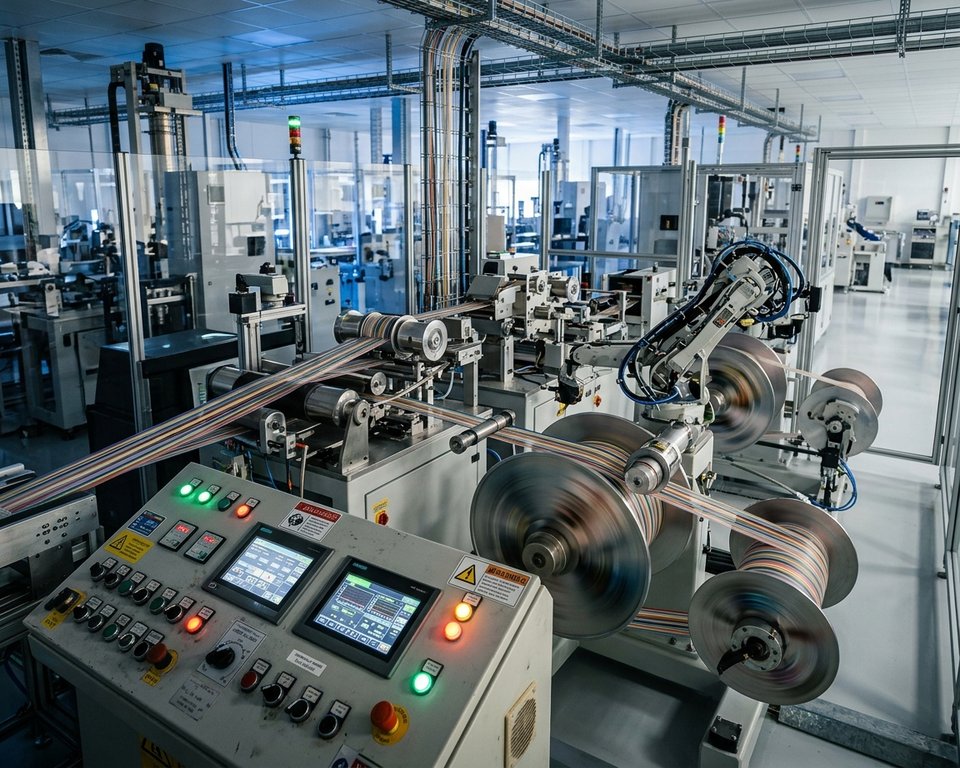 Intermittent Bonded Ribbon Production Line
Equipment Designed For Twelve- And Sixteen-Fiber Rollable Ribbon Production
Two fiber-count options are supported by the configuration for manufacturing rollable ribbons. Buyers can use these options as a starting point for checking compatibility with target formats, fiber sizes, and handling requirements.
How Intermittent Bonding Supports Flexible Fiber Arrangement
The patent’s design examples describe neighboring fiber subunits joined by adhesive bonds positioned at intervals. One illustrated spacing range extends from 10 mm to 1,000 mm. Unlike continuous bonding, this arrangement does not join the fibers along their entire length.
By spacing the bonds apart, the assembly can move between a mostly planar arrangement and a rolled, curled, or folded shape. The specified spacing illustrates the patented design concept rather than confirmed production-machine settings.
- Machine details: 12 or 16 fibers, a stated speed of 600 m/min, and a diameter of Ф245 μm ±10 μm.
- Patent example: Illustrative spacing between adhesive bonds of 10 mm to 1,000 mm.
- Design benefit: Flexible handling across several possible shapes.
Applications In Optical Fiber Cable Manufacturing
Flexible ribbon arrangements can help cable designers balance access for splicing with compact cable packaging. The patent outlines a configuration that maintains fiber organization while allowing portions to move between adhesive connection points during cable assembly.
High Fiber Density And Compact Cable Designs
For mass fusion splicing, an optical fiber ribbon can be arranged flat before being folded or rolled into a more compact cable. Potential advantages described in the patent include smaller cable constructions and an increased ratio of fiber area to overall cable cross-sectional area. The results achieved in practice depend on the complete cable construction and its intended use.
Ribbon Organization For Efficient Fusion Splicing
The ribbon format enables organized handling at the splice location while allowing the subunits to move during cable assembly. The manufacturer’s material-handling specifications identify payoff reel capacities of 25.2 km and 50.4 km of fiber. Buyers can evaluate these capacities against their production requirements and existing handling arrangements.
| Design detail | Potential use | Buyer consideration |
|---|---|---|
| Planar fiber arrangement | Mass fusion splicing | Confirm requirements for the splice workflow |
| Ribbon configuration that folds or rolls | Space-efficient cable packaging | Review the overall cable construction |
| 25.2 km and 50.4 km capacity payoff reels | Material-handling preparation | Align reel capacities with operating needs |
Specifications And Performance Of The Production Line
Compare the equipment’s published performance figures with your manufacturing requirements before requesting a quotation. Installation preparations should also account for suitable reels and the utilities available at the production site.
Production Speed, Fiber Diameter, And Attenuation
The stated construction speed is 600 m/min. The specified fiber diameter is Ф245 μm ±10 μm, while additional attenuation is stated as ≤0.01 dB/km at 1550 nm. Ask the supplier to verify the testing conditions and achievable results.
Payoff And Take-Up Reel Compatibility
Two payoff reel sizes are offered, with each full reel limited to 10 kg. For take-up, the equipment accepts either a T-type reel or a fiber-optic reel. Verify that your selected reel configuration is compatible with the facility’s material-handling process.
Facility Utilities And Operating Environment
Plan for a 380 V ±10% power connection using a three-phase, five-wire system. The equipment should operate in an enclosed, clean, dry, draft-free area maintained at 15 to 25°C and a maximum relative humidity of 85%. Utility requirements also include nitrogen at 7 bar and 99.99% purity, plus a compressed-air supply at 6 bar. Verify the required utility connections before installation begins.
| Technical specification | Published requirement | Installation planning note |
|---|---|---|
| Reels for fiber payoff | Ф236 × Ф25.4 × 108 mm; Ф267 × Ф25.4 × 180 mm; maximum full-reel weight ≤10 kg | Verify reel dimensions and weight |
| Take-up reel | T-type reel: Φ410 × Φ50.8 × 391 mm, alternatively a fiber-optic reel | Confirm compatibility with your selected format |
| Electrical and environmental requirements | 380 V ±10%; 15 to 25°C; relative humidity ≤85% | Prepare a dry, clean, draft-free operating area |
| Gas utility supply | Nitrogen: 7 bar, 99.99% purity; air: 6 bar | Check available gas capacity before equipment setup |
Equipment For Fiber Payoff And Gathering
Optical fibers are guided toward the forming section by the payoff and gathering components. The associated controls help maintain a steady supply of fiber while reducing handling risks.
Sixteen-Spool Payoff With Tension Control
The payoff assembly holds 16 spools and provides traversing along with separately adjustable tension settings. The permitted weight for an individual spool is up to 10 kg. The technical details list 0.4 to 2 N tension with ±0.02 N accuracy, together with a 550 W motor. Because a separate overview states 40 to 150 g with ±2 g accuracy, ask the manufacturer to clarify the correct values for your intended setup.
Fiber Guiding, Break Detection, And Electrostatic Control
The forming area receives fibers through U-groove guides, multi-groove gathering rollers, and devices designed to prevent jumping. A break-detection system and alarms notify operators when problems occur. Protective guards and pneumatic clamping provide additional support for safe material handling. A rod-type electrostatic dust collector is positioned at the fiber exit, and additional anti-static devices help control dust throughout the gathering path.
| Equipment component | Listed detail | Purpose |
|---|---|---|
| Fiber payoff assembly | Capacity for 16 spools, each weighing up to 10 kg | Supplies fibers using traversing |
| Tension and motor | 0.4 to 2 N with ±0.02 N accuracy; 550 W | Maintains controlled fiber payoff |
| Fiber guidance and safety features | Grooved rollers, alarms, guards, and pneumatic clamping | Guides fiber movement and assists material handling |
| Static control | Rod-type dust collector and anti-static equipment | Helps reduce dust near fiber routes |
Intermittent Adhesive Dispensing And Precision Molding
Operators can adjust adhesive positioning and mold alignment through the forming platform. These settings allow the production process to be adapted to the intended ribbon configuration.
Ribbon Formation Using An Adjustable IBR Mold Platform
Ribbon formation uses three mold assemblies, each capable of holding up to five Nordson EFD jet valves. Operators can position the mold within 0 to 15 mm and adjust its base temperature from 20°C to 60°C. Precision valve groups mounted on sliding tables allow fine positioning and accurate application of adhesive dots.
Configurable Nozzle Arrangements For Twelve- And Sixteen-Fiber Ribbons
The 12-fiber configuration employs a 5+5+1 valve arrangement. Production of the 16-fiber format uses a 5+5+5 configuration. The control interface enables changes to dot count and spacing according to the ribbon configuration being manufactured. A dedicated adhesive is required for the coating and curing stages.
| Process setting | Format With 12 Fibers | 16-Fiber Format |
|---|---|---|
| Dispensing valve layout | 5+5+1 valve configuration | Valve arrangement of 5+5+5 |
| Mold adjustment | Adjustment range of 0 to 15 mm | 0 to 15 mm adjustment |
| Temperature of the mold base | Temperature range of 20°C to 60°C | 20°C to 60°C operating range |
UV-LED Curing For Bonded Fiber Ribbons
Adhesive across the fiber assembly is cured through a sequence of UV exposure stages. Prospective buyers can assess the oven configuration and listed operating specifications to determine whether the equipment suits their production process.
Initial Pre-Curing And Main Curing Operations
Pre-curing is handled by three specialized 800 W LED-UV ovens. Each oven processes fibers supplied by a separate mold group before the material reaches the main 6 kW post-curing oven. The system uses adjustable shutters to help contain UV exposure and minimize nitrogen losses. Published specifications identify a dominant wavelength of 395 nm ±3 nm, a curing degree of at least 85%, and post-curing power of at least 2.5 kW.
Managing Nitrogen Supply And Curing Performance
The nitrogen flow rate and pressure can be adjusted by hand. The system additionally switches nitrogen on when starting and off when shutting down. At production speed under continuous stable conditions, the specified lamp-array power consumption is no more than 80% of total power. The figures are useful for initial equipment assessment, but buyers should confirm the conditions under which they were measured. Discuss how the operating settings may change depending on the adhesive and materials selected.
Visual Monitoring, Capstan, And Take-Up
Visual inspection and consistent winding help preserve fiber quality as material passes through the production line. The published operating settings also offer buyers useful criteria for comparing equipment against their cable production requirements.
Real-Time Inspection Of Fiber Colors And Adhesive Dot Placement
A microscope and camera provide enlarged images in real time. Operators can inspect optical-fiber color order and verify the presence of resin dots at individual dispensing locations. By examining the optical fiber ribbon during production, operators can detect potential issues ahead of winding.
Servo-Driven Traction And Precision Take-Up
The Φ190 mm capstan traction wheel is driven by a 1 kW AC servo motor. Metering accuracy is specified as better than 1‰. Operators can set tension between 50 and 500 g while maintaining an accuracy of ±5 g. Together, these settings support controlled movement and handling of the fiber ribbon.
The specified take-up speed is 600 m/min, and the maximum spool weight is 30 kg. The servo-driven take-up and traversing assemblies support uniform positioning during winding. Cable pitch can be adjusted continuously between 1 and 6 mm. A photoelectric sensor monitors position and assists with reversing direction. Confirm that the operating conditions and settings are suitable for your target cable design with the supplier.
Production Monitoring And Electrical Control Systems
Clear control functions help production staff manage settings, monitor system conditions, and prepare smooth stopping procedures. The supplier identifies Siemens control equipment and Schneider Electric switchgear as components of the production line.
PLC And Touchscreen Operation
The ribbon production line uses Siemens S7-1200 and S7-1500 PLCs with a 10.4-inch Siemens touchscreen interface. Low-voltage switchgear is supplied by Schneider Electric. Operators may control the entire line with interlocked units or run individual sections independently.
Process Settings, Warning Alarms, And Preset-Length Shutdowns
Through the touchscreen, operators can manage process settings, activate curing ovens, configure wire feeding, and view alarms. Additional displays provide lamp runtime, real-time current readings, curing-oven temperature, and total machine operating hours. A meter-counter correction function helps synchronize displayed length measurements with actual material movement.
Operators can program a target production length that triggers deceleration or shutdown. The function supports managed stopping as a cable manufacturing run reaches its planned length. Ask the manufacturer to confirm control capabilities and setup requirements before placing an order.
| Control feature | Listed detail | Use |
|---|---|---|
| PLC controls and operator display | Siemens S7-1200/S7-1500; 10.4-inch touchscreen | Adjust and review operating information |
| Electrical components | Low-voltage switchgear from Schneider Electric | Supports electrical control operations |
| Equipment monitoring and shutdown control | Operating data for lamps, ovens, runtime, and meters; preset-length function | Monitor production and stop or decelerate the equipment |
Materials, Process Compatibility, And Ribbon Quality
The selected adhesive influences coating uniformity and the quality of the finished ribbon. Rather than recommending a general adhesive, the supplier specifies a formulation dedicated to the equipment’s coating and curing operations.
Dedicated Adhesive For Bonding And Curing
Separate valve switches on the pressurized adhesive supply let operators control individual feed paths. Precision pressure-regulating valves help maintain controlled adhesive delivery at each dispensing location. Air pressure can be regulated but must remain at or above the listed minimum of 0.5 MPa.
Black adhesive supply tubing helps protect the material from reactions caused by UV exposure during operation and curing. Preventing unintended exposure matters because adhesive behavior could be affected before the material reaches the fiber surface.
Confirm suitable adhesives, process parameters, and surface-finish requirements with the manufacturer before choosing materials for a secondary coating operation. Discuss the material’s expected performance across your planned application and run duration. Detailed manufacturing guidance can support consistent quality throughout setup and the completed run.
Equipment Installation Needs And Supplied Documentation
Ensure the workspace and utility supplies are ready before scheduling the machine’s installation. The supplier’s specifications provide guidance for planning the production site and supporting consistent operation of the fiber-optic machinery.
Facility Conditions And Buyer-Supplied Connections
Install the machinery in a clean, dry, enclosed environment protected from drafts. Keep the operating area between 15 and 25°C, with humidity at or below 85%. Provide nitrogen at 7 bar and 99.99% purity, along with compressed air at 6 bar.
The equipment package does not include connecting cables or cable trays. The buyer must arrange the principal power feed-in cable. Before installation, check cable routing and utility capacity, particularly when the machine will be located near secondary coating operations.
Documentation For Operation, Installation, And Maintenance
The supplier includes documentation supporting machine installation, operation, and servicing. Review these records before startup to help staff plan work activities and identify necessary supplies.
- Instruction manuals, operating guides, and a general layout drawing
- Wiring and electrical schematic diagrams, plus installation and maintenance drawings
- Manuals for purchased parts and a list of wear parts for maintenance planning
These documents help maintenance and production teams prepare for initial startup and regular equipment care.
Choosing A Ribbon Production Line For Your Manufacturing Needs
Begin by identifying the ribbon formats you intend to manufacture and sell. The machinery supports 12F and 16F formats and has a stated construction speed of 600 m/min. Compare those specifications with your expected product mix, production targets, and anticipated cable demand.
Verify take-up reel compatibility before placing an equipment order. A standard IBR reel measures Φ410 × Φ50.8 × 390 × Φ310 mm, accommodates a maximum weight of 30 kg, and allows cable pitch settings between 1 and 6 mm. Confirm that the listed reel dimensions, capacity, and pitch range are appropriate for your site and handling process.
Payoff reel compatibility also deserves attention. Available options include international-standard spools accommodating 25.2 km, 50.4 km, and 63 km. Request precise reel measurements before selecting materials or determining production run lengths.
In addition to speed, consider power and gas utilities, suitable adhesives, and the available monitoring functions. Assess whether the equipment arrangement is appropriate for fiber cable, loose tube, or the specific application in your cable production process. Before ordering, review equipment configuration and startup requirements directly with Shanghai Weiye. A thorough compatibility assessment can help prevent expensive modifications later.
| Planning point | Listed detail | Buyer check |
|---|---|---|
| Ribbon configurations and operating speed | 12F, 16F; specified speed of 600 m/min | Compare with target production and product mix |
| Take-up configuration | 30 kg maximum capacity; adjustable pitch from 1 to 6 mm | Verify that the reel and site arrangements are suitable |
| Payoff spools | 25.2 km, 50.4 km, and 63 km spool capacities | Confirm the precise reel measurements |
How To Request A Quotation For The Intermittent Bonded Ribbon Production Line
U.S. buyers can evaluate a system offering 12F and 16F formats, a specified construction rate of 600 m/min, and specialized optical fiber ribbon-forming equipment. Compare these features with your planned cable products to assess equipment suitability.
A pricing inquiry should include your chosen format, projected production quantity, reel requirements, and facility utility details. Also describe the fiber type and handling requirements so Shanghai Weiye can evaluate the proposed configuration.
Confirm the suitability of the adhesive, the LED wavelength specification of 395 nm ±3 nm, and expected curing results before purchasing. Ask the supplier how these parameters relate to the chosen materials and required surface quality.
Use the manufacturer’s product listing to examine the equipment information. Verify the final configuration, shipment details, and installation commissioning with Shanghai Weiye Optic Fiber Communication Equipment Co., Ltd. The supplier provides its address as 201 Minyi Road, Songjiang District, Shanghai. You can call 021-60701630 to review your project needs with the supplier. Providing complete information in your quote request makes the following stages easier to clarify.